Telephone
02-77093611
Line
@fdlaw
address
17th Floor, No. 180, Section 2, Dunhua South Road, Da'an District, Taipei City
Telephone
02-77093611
Line
@fdlaw
address
17th Floor, No. 180, Section 2, Dunhua South Road, Da'an District, Taipei City


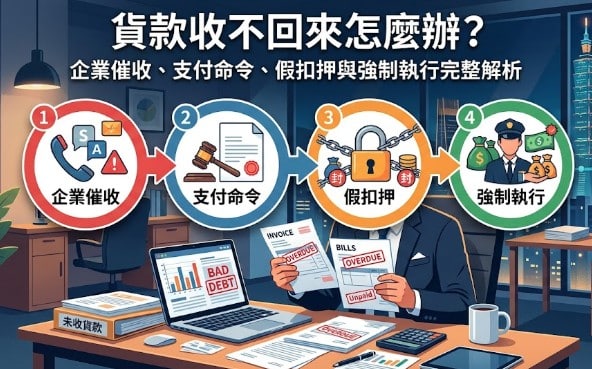
Clients saying they'll remit payment next week, the accountant is still processing the paperwork, the boss is abroad, and invoices need to be reissued—these are common occurrences in business transactions. The real danger isn't a few days' delay in payment, but rather the other party starting to avoid you, contradicting each other's accounting records, requesting installment payments without signing a written agreement, relocating their company, having bank checks returned, or even rumors of bankruptcy, asset stripping, or being pursued by other creditors.
When payments are uncollectible, businesses should handle two things simultaneously. First, confirm the clarity of the debt, meaning whether contracts, quotations, orders, shipping documents, acceptance records, invoices, account statements, and LINE or email correspondence are sufficient to prove the debt. Second, determine if the debtor has any assets available for enforcement, because a civil victory only provides the legal basis for enforcement; the real goal remains recovering the money.
Taking the payment for goods as an example, Article 367 of the Civil Code clearly stipulates that the buyer has the obligation to pay the agreed price and take delivery of the subject matter to the seller. In other words, as long as the company has delivered the goods, completed the service, or fulfilled the main obligations of the contract, the other party cannot indefinitely delay payment simply by saying that "the internal process is not yet ready."
The biggest problem in debt collection is relying solely on verbal agreements. When courts review payment orders, preliminary attachments, or lawsuits, they don't look at whether the company believes the other party owes money, but rather whether the documents can convince the court that the debt exists.
I. The basis of the transaction should include a signed contract, quotation, purchase order, order form, memorandum of understanding, or communication records sufficient to prove the terms of the transaction. If the transaction is usually confirmed via email or messaging software, the complete dialogue should be preserved, and not just a single sentence.
Second, proof of performance should include delivery notes, receipts, logistics records, acceptance forms, completed photos, delivery records, invoices, payment requests, and statements of account. If the other party has indicated "received," "no problem," or "payment next week," such wording can help reduce their future claims of non-delivery, non-acceptance, or quality defects.
Third, collection records should include collection emails, documented letters, payment commitments, installment agreements, bounced check records, and the reasons the other party refuses to pay. This information not only affects the outcome of the lawsuit but may also affect whether a preliminary attachment can be requested, as the court will assess whether the other party is at risk of evading payment, has financial irregularities, or faces future enforcement difficulties.
Many companies ask, "Will the other party be afraid if I send a letter of deposit?" The answer is not necessarily. The real value of a letter of deposit is not to get the other party to pay immediately, but to formally establish the terms of the debt, the payment deadline, the fact of default, and subsequent legal action.
For businesses, a formal collection letter typically serves three functions. First, it informs the recipient that the company has entered into a formal collection process, rather than just a private reminder from a sales or accounting staff member. Second, it confirms whether the recipient acknowledges the debt, raises objections, or asserts a set-off. Third, it establishes a written record for subsequent payment orders, litigation, preliminary attachment, or settlement negotiations.
However, if the other party has clearly ceased operations, closed down, its responsible person is unreachable, or its assets may be rapidly transferred, the company should not simply send repeated letters. In this case, it should immediately assess whether to issue a presumptive attachment order, a payment order, or a lawsuit, to avoid spending time on collection tactics and ultimately turning the debt into an unrecoverable bad debt.
Payment orders are suitable for cases where the amount of the debt is clear, the evidence is relatively clear, and the other party is unlikely to substantially dispute the claim. Article 508 of the Civil Procedure Law stipulates that if a creditor's request is for payment of a certain amount of money or other substitutes or securities, the creditor may petition the court to issue a payment order through summary proceedings.
When applying for a payment order, according to Article 511 of the Code of Civil Procedure, the applicant should state the parties involved, the object and quantity of the claim, the facts underlying the claim, the statement of the court that the payment order should be issued, and the creditor's request should be clearly stated. For corporate debt cases, this means that simply stating "the other party owes my company money for goods" is insufficient; the transaction date, items, amount, payment deadline, delivery details, and outstanding amount must be clearly stated.
The advantages of a payment order are its speed, lower cost, and simpler procedure. The risk is that the debtor can raise an objection without reason within 20 days of receiving the payment order; if a legitimate objection is raised, the payment order becomes invalid within the scope of the objection, and the case will proceed to litigation or mediation. Articles 516 and 519 of the Civil Procedure Law explicitly address this.
If the debtor does not object within the statutory period, the payment order can become the basis for enforcement, and the creditor can apply for compulsory execution. This provision is stipulated in Article 521 of the Civil Procedure Law.law.moj.gov.twTherefore, a payment order is not simply a demand for payment, but a legal procedure that can lead directly to enforcement.
Presumptive attachment is the most important, yet most misunderstood, tool in corporate debt recovery. Simply put, presumptive attachment is not about getting the money back first, but about preserving the debtor's assets before a judgment or payment order is finalized, to avoid being unable to enforce the judgment even if the debtor wins the case later.
Article 522 of the Civil Procedure Law stipulates that a creditor may apply for provisional attachment in order to preserve the property for enforcement of a monetary claim or a claim convertible into monetary value. However, Article 523 also explicitly restricts this, stipulating that provisional attachment can only be granted if there is a risk that enforcement will be impossible or difficult in the future.
This means that courts generally will not grant a preliminary attachment simply because "the other party owes money." The company must also provide evidence that convinces the court of the necessity for preservation, such as the other company ceasing operations, relocating, defaulting on checks, its responsible person being unreachable, selling large quantities of equipment, abnormal asset transfers, other creditors having already enforced judgments, or the other party explicitly refusing to pay after being urged to do so and exhibiting a significant deterioration in its financial situation.
Article 526 of the Code of Civil Procedure stipulates that the request and the reasons for provisional attachment should be explained; even if the creditor is willing to provide security, it does not completely replace the explanation. In practice, many provisional attachments are rejected not because the debt does not exist, but because the creditor only says "I am afraid that the other party will transfer assets" without providing any information that can be investigated immediately to support this risk.
There is no single standard answer to accounts receivable collection for enterprises. The key is to choose the appropriate procedure based on the other party's attitude, the strength of the evidence, and the financial risk.
First, if the claim is clear, the amount is specific, and the other party is merely delaying payment, a payment order is usually a procedure that can be prioritized for evaluation. It can test whether the other party will dispute the claim in a relatively short period of time, and may also directly obtain enforcement authority.
Second, if the other party has already asserted quality defects, shortages, set-off, contract termination, or other substantial disputes, direct litigation or mediation may be more suitable. This is because the other party will almost certainly object to the payment order, and the company will still have to return to litigation to deal with evidence and legal issues.
Third, if the other party faces risks such as asset stripping, bankruptcy, business closure, bounced checks, or rapid transfer of assets, a preliminary attachment should be prioritized. A preliminary attachment can be used in conjunction with litigation, payment orders, or mediation in this case. According to Article 529 of the Civil Procedure Law, if the case is not yet settled, the debtor may also petition the court to order the creditor to file a lawsuit within a certain period; and in specific circumstances, petitions for payment orders, mediation, or arbitration may have the same effect as a lawsuit.
Fourth, if a definitive payment order, a favorable judgment, a mediation record, a settlement record, or other enforcement document has been obtained, the next step is enforcement. Enforcement focuses not only on filing the lawsuit, but also on identifying the enforceable object, such as bank deposits, accounts receivable, real estate, vehicles, equipment, equity, or third-party payment obligations to the debtor.
Yes. The most frequently overlooked risk in debt collection by businesses is the assumption that "the debt is there and can be collected forever." Article 125 of the Civil Code stipulates that a right to claim debt is extinguished in principle if it is not exercised within 15 years, unless the law provides for a shorter period.law.moj.gov.tw)
For common commercial transactions, Article 127, Paragraph 8 of the Civil Code stipulates that the consideration for goods and products supplied by merchants, manufacturers, and craftsmen shall be extinguished if not exercised within two years.law.moj.gov.twTherefore, in the case of payments for goods, businesses cannot leave overdue payments unpaid indefinitely, hoping the other party will have a change of heart. The actual statute of limitations needs to be determined based on factors such as the nature of the contract, the basis of the claim, whether the debt has been acknowledged, and whether the statute of limitations has been interrupted. It is recommended to consult a lawyer in the early stages of overdue payments.
If the debtor may already be able to raise the statute of limitations defense, businesses should avoid relying solely on telephone collection. They should immediately check payment deadlines, the last date of acknowledgment of debt, installment commitments, account statements, remittance records, and whether any legal action has been taken to interrupt or preserve their rights.
The common reason for failures in corporate debt recovery is not the complete lack of legal basis, but rather acting too late. By the time the other party's company goes out of business, its bank accounts are empty, and the person in charge has no assets, even a favorable judgment may only be a right on paper.
In practice, situations where you really need to consult a lawyer immediately include: the other party starts avoiding you, payment promises are repeatedly broken, the company's registered address or business location is abnormal, the person in charge sets up a new company to take over the business, the other party asks you to continue supplying goods but old debts are not cleared, the other party says they are handling debt negotiations, or other suppliers also start chasing for payment.
When handling corporate debt collection, Fidelity Law Firm first assists in determining whether the debt documentation is sufficient, whether a payment order is appropriate, whether conditions for preliminary attachment exist, whether a direct lawsuit should be filed, and which assets might be locked up by enforcement. For businesses, a good collection strategy is not about going through every procedure, but about selecting the right procedure in the shortest possible time to improve the recovery rate.
When payments are uncollectible, businesses should avoid three common mistakes. First, do not wait indefinitely without a written commitment. Second, do not let the statute of limitations and opportunities for asset preservation slip away for fear of damaging relationships. Third, do not simply hand the problem over to sales or accounting for collection efforts without having legal counsel or lawyers examine the evidence and procedural options.
If the amount is already impacting cash flow, or if the other party shows signs of financial irregularities, the company should promptly submit contracts, orders, invoices, statements, collection records, and payment commitments to a lawyer for evaluation. The earlier the review, the better the chance of making the right choice among payment orders, preliminary attachment, litigation, and enforcement.
Fidelity Law Firm can assist businesses with Taiwanese business contracts, payment collection, accounts receivable management, payment orders, injunctive relief, civil litigation, enforcement, and other matters.Cross-border business debt recoveryIf your company is facing issues such as customers not paying, suppliers defaulting on payments, or potential business partners being suspected of asset stripping, it is advisable to consult a lawyer as soon as possible to avoid missing the best opportunity for asset preservation and collection.
Not necessarily. Unpaid goods are usually considered a civil debt or breach of contract issue initially, unless there was fraudulent activity, a lack of intent to pay, a false claim of transaction capability, or other evidence sufficient to constitute fraud. When faced with non-payment from customers, businesses should first compile contracts, shipment records, account reconciliation records, and collection records, and then have a lawyer determine whether it falls under civil collection, payment orders, preliminary injunction, or whether there is further grounds for criminal prosecution.
Not necessarily. The function of a payment order is to help creditors obtain enforcement authority more quickly, but debtors can raise objections within the statutory period. Even if the payment order is finalized, it still depends on whether the debtor has assets available for enforcement. Therefore, companies should not only ask whether they can apply for a payment order, but also assess the other party's assets, payment ability, and whether a provisional attachment is necessary.
No. Courts will usually still require creditors to explain the existence of the debt and the reasons for the preliminary attachment. If a company only has contracts and invoices but cannot explain the risk that the other party will be unable to enforce the judgment or that enforcement will be difficult in the future, the preliminary attachment may still be rejected. A security deposit can supplement some of the insufficient explanation, but it cannot completely replace the explanation of the necessity of the preservation.
If the other party repeatedly delays payment, refuses to reconcile accounts, demands unreasonable discounts, the person in charge is unreachable, the company's operations are abnormal, or the amount has affected cash flow after the payment deadline, a lawyer should be consulted for an assessment. If it involves payment for goods, special attention should be paid to the possibility of a shorter statute of limitations, and long-term collection efforts cannot rely solely on phone calls or messages.
First, it's essential to assess whether there are any executable assets and opportunities for preservation. The other party claiming to have no money doesn't necessarily mean they have no assets; they may still possess bank deposits, accounts receivable, equipment, real estate, vehicles, or third-party payment claims. If you wait until the asset transfer is complete before filing a lawsuit, even if you win, it may be difficult to recover the assets. Therefore, a lawyer should assess whether to first apply for a preliminary injunction or other preservation procedures.
Fuda Law Firm
Line:https://line.me/ti/p/@fdlaw
Tel: 0277093611
Facebook:https://www.facebook.com/fudalawyer
website:https://fdlaw.com.tw/
e-mail:info@fdlaw.com.tw
If you encounter legal issues similar to those described in this article, you typically need to consider contracts, financial transactions, records, company documents, and litigation risks simultaneously, rather than just looking at a single legal provision. Below is a summary of related topics and services offered by Fidelity Law Firm that can be further explored after reading this article.
It is necessary to examine the evidence of the debt, the other party's assets, payment commitments, and whether there is a risk of asset stripping; in some cases, a preliminary attachment or payment order should be issued first.
If it's just a matter of not paying afterwards, it's usually more of a civil case; only if there was fraudulent activity, no intention to pay, or a fraudulent transaction from the beginning can it be assessed as criminal fraud.
Contracts, orders, shipping documents, invoices, statements of account, payment records, collection notices, and information acknowledging the debt from the other party are all important.
If you are dealing with company, responsible persons, contracts, financial transactions, investigative, or litigation risks, it is recommended that you first organize the facts, documents, and potential legal proceedings together, rather than relying on a single keyword. The following content can help you explore related topics further and quickly determine your next steps.
Not necessarily. Simple non-payment is usually still a civil debt, but if there is fraud, fictitious transactions, forgery, or malicious disposition of assets from the outset, then criminal fraud, breach of trust, or other liabilities need to be assessed.
First, preserve contracts, orders, invoices, delivery or acceptance records, chat logs, and payment information, then determine whether to send a lawyer's letter, request a payment order, file for preliminary attachment, or directly file a lawsuit.
Disputes over payment for goods often involve contract terms, trade practices, performance defects, the responsibility of company leaders, and future cooperation relationships. Business lawyers can assist in choosing the most efficient recovery route.
If you need legal assistance to determine the next step, you can first organize the above documents and timeline, and then contact Fidelity Law Firm for assistance in assessing the direction of the process. Contact Fidelity Law Firm
