Telephone
02-77093611
Line
@fdlaw
address
17th Floor, No. 180, Section 2, Dunhua South Road, Da'an District, Taipei City
Telephone
02-77093611
Line
@fdlaw
address
17th Floor, No. 180, Section 2, Dunhua South Road, Da'an District, Taipei City


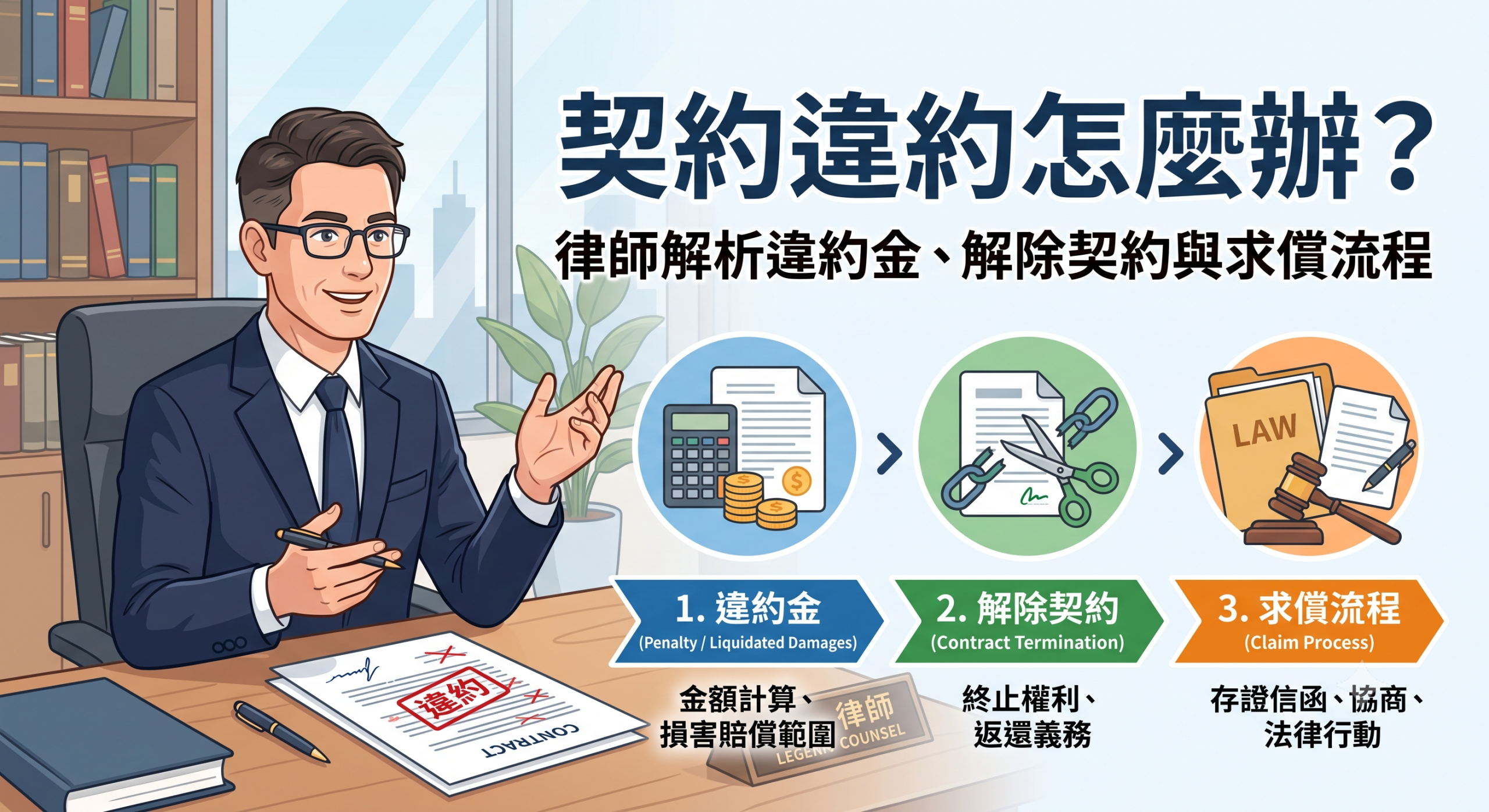
Key Points
When a breach of contract occurs, businesses or individuals should first confirm whether the contract is still enforceable, whether the conditions for termination have been met, whether the penalty for breach of contract may be reduced by the court, and whether the evidence for damages is complete. Incorrect order of processing may render a potentially favorable claim ineffective due to insufficient evidence or unclear legal consequences.
The company signs a purchase contract, but the manufacturer fails to deliver the goods on time; the customer signs a service contract but suddenly refuses to pay the final payment; the partner promises investment, agency, distribution, or confidentiality but then reneges. When faced with a breach of contract, many people's first reaction is to immediately terminate the contract, seek compensation, deduct money, or demand that the other party pay liquidated damages. However, the real key is not emotions, but whether you can organize the case into a legal claim that the court can understand and that the other party cannot easily refute.
Data verification as of July 10, 2026. Under Taiwan's civil law framework, breach of contract typically involves non-performance of obligations, delayed payment, incomplete payment, termination of the contract, damages, and liquidated damages. If the order of processing is incorrect—for example, terminating the contract without prior notice, claiming high compensation without preserving evidence of damages, or writing excessively high liquidated damages—subsequent litigation may not necessarily support all aspects of the contract.
Breach of contract is not only dealt with by "paying compensation". If the other party is still capable of performing the contract, the first approach is usually to require the other party to continue to perform, such as delivering goods, making payments, providing services, transferring rights, or rectifying defects. If the other party's performance has been delayed or the quality is not conforming, it is necessary to further determine whether it constitutes delayed performance, incomplete performance, or inability to perform.
according toArticle 227 of the Civil CodeIf incomplete performance is caused by reasons attributable to the debtor, the creditor may exercise its rights based on the provisions for delay or inability to perform; if other damages arise as a result, it may also claim compensation. This is particularly common in engineering, software development, consulting services, supply chain delivery, and business cooperation, because the other party is not completely negligent, but rather performs in a manner inconsistent with the agreement.
The scope of damages depends on...Article 216 of the Civil CodeIn principle, damages are limited to compensating the creditor for the losses suffered and the profits lost. In other words, a company cannot simply say "I feel the loss is significant," but must provide evidence of the actual increased costs, expenses already incurred, business losses caused by delays, price differences from alternative purchases, customer attrition, or anticipated profits.
In most cases, it is not advisable to immediately terminate the contract upon discovering delays by the other party.Article 254 of the Civil CodeWhen one party to a contract delays payment, the other party should typically set a reasonable period for demanding performance. Only if the other party still fails to perform within that period can the contract be terminated. In practice, demanding performance is not merely a formality, but rather crucial evidence to prove the legality of subsequent termination.
The notice of demand should clearly state the contract name, the facts of the breach, the matters to be performed, the deadline for rectification, and that failure to perform within the deadline will result in termination of the contract and a claim for damages or liquidated damages. If you simply send a message on LINE asking "When are you going to deal with this?", the other party may later claim that it is not a formal notice of demand or that the notice is not clear enough.
However, some contracts emphasize specific time points; if the contractual purpose cannot be achieved after that time, further reminders may not be necessary.Article 255 of the Civil CodeDepending on the nature of the contract or the parties' intentions, if the purpose of the contract cannot be achieved without payment within a certain period, and one party fails to make payment on time, the other party may terminate the contract without prior notice. For example, whether a contract can be terminated without notice if exhibition equipment is not completed before the exhibition period, wedding venue cannot be provided on the day of the event, or limited-time products miss their sales period depends on whether the purpose of the contract and the evidence are sufficiently clear.
Yes. Terminating a contract does not wipe out all responsibilities.Article 259 of the Civil CodeAfter the termination of the contract, both parties are, in principle, obligated to restore the original state, such as returning received payments, returning received goods, accruing interest on the money, or repaying received benefits.Article 260 of the Civil CodeThe exercise of the right of rescission does not preclude a claim for damages.
In practice, the most confusing point is that after contract termination, one can not claim all the imagined benefits, but rather damages that are causally related to the other party's breach of contract. For example, if a company urgently purchases goods from a third party at a higher price because the supplier failed to deliver, the price difference, additional shipping costs, storage fees, and penalties for customer breach of contract, if supported by documents, contracts, invoices, and transaction records, will be more convincing than a vague claim of "damaged goodwill."
Before terminating a contract, companies should assess three things. First, whether the contract or law requires prior notice. Second, whether evidence of the other party's breach of contract and their own damages has been preserved. Third, whether, after termination, it is still necessary to retain the validity of clauses concerning claims for damages, liquidated damages, confidentiality, non-competition, intellectual property, or jurisdictional courts. The real risk in many business contract disputes lies not in whether the contract can be terminated, but in whether effective compensation can be sought after termination.
Not necessarily.Article 250 of the Civil CodeThe parties may agree that the debtor shall pay liquidated damages in the event of non-performance. If the parties have not otherwise agreed, liquidated damages are generally considered a predetermined amount of damages for non-performance. The advantage of this design is that it reduces the burden on the creditor to prove each item of damages.
However, a higher penalty clause doesn't necessarily mean greater safety.Article 252 of the Civil CodeIf the agreed-upon penalty for breach of contract is excessively high, the court may reduce it to a reasonable amount. If the debtor has already performed part of the obligation...Article 251 of the Civil CodeIt also stipulates that the court may reduce the penalty for breach of contract by analogy to the benefits received by the creditor from partial performance.
In practice, the Supreme Court has consistently held that whether liquidated damages are excessive typically considers general objective facts, socioeconomic conditions, the damages suffered by the parties, the benefits the creditor would have enjoyed had the debtor performed on time, and whether the liquidated damages are a predetermined amount of damages or have a punitive nature. This is evident in Supreme Court Civil Judgments No. 1406 of 2011 and No. 2692 of 2012, where the court first determines the nature of the liquidated damages and then considers whether to reduce them based on the specific damages and performance circumstances of each case.
If you are the party being asked to pay liquidated damages, you cannot simply say it's "too expensive" or "unfair." An effective defense should return to evidence. You need to explain the actual extent of the other party's damages, how much you have performed, whether the breach of contract is attributable to you, whether the other party also failed to fulfill their cooperative obligations, whether the liquidated damages are disproportionate to the total contract price or transaction risk, and whether the other party has already received compensation from other sources.
If liquidated damages have already been withheld by the other party—for example, if project payments, security deposits, performance bonds, or final payments have been withheld—further analysis is needed to determine whether the withholding has a contractual basis, whether the withholding ratio is reasonable, whether the other party has completed the necessary notification procedures, and whether a refund can still be claimed based on unjust enrichment or a payment request. A common mistake companies make in these cases is waiting until they are sued to gather information; in fact, a complete timeline should be established from the first day the breach of contract notice or withholding notice is received.
In breach of contract cases, the most important evidence is not just the contract itself, but how the contract was performed, how it was breached, and what damages were caused by the breach. In practice, formal contracts, quotations, purchase orders, purchase orders, acceptance documents, meeting minutes, emails, LINE conversations, payment records, invoices, shipping documents, photos of defects, demand letters, lawyer's letters, alternative transaction documents, and damage calculation sheets should be organized in chronological order.
If the case involves internal company decisions, records of board or executive decisions should be kept to prove that the company took alternative measures, canceled projects, compensated customers, or increased expenses due to the other party's breach of contract. For cross-border business contracts, the governing law, court of jurisdiction, arbitration clause, service address, language version priority, and authorization documents from the foreign company should also be confirmed. These clauses may seem standard in practice, but they directly affect where to file a lawsuit, what law to use, and whether the judgment or arbitration result can be enforced in the event of a dispute.
When faced with a breach of contract, the best strategy for businesses is not to make a definitive statement from the outset, but to retain options. If the other party still has value in fulfilling the contract, a formal notice and deadline for rectification can be used to force the other party to take a stand. If the other party is clearly unable to fulfill the contract, the termination, alternative procurement, preservation of evidence, and amount of compensation should be assessed quickly. If the other party shows signs of divestiture, business closure, or abnormal funds, a preliminary attachment or other preservation procedures should also be assessed simultaneously.
When handling business contracts, corporate transactions, cross-border collaborations, and corporate disputes, Fidelity Law Firm typically assists clients by first clarifying contract terms, breach of contract facts, the strength of evidence, and negotiating leverage before deciding whether to send a letter, negotiate, request a payment order, file a civil lawsuit, request a preliminary injunction, or initiate arbitration. Contract breach is not simply about writing a strong lawyer's letter; it's about ensuring each step connects to subsequent claims and enforcement.
Not necessarily. If the other party is merely delaying performance, it is usually necessary to first issue a demand for performance within a reasonable period according to Article 254 of the Civil Code. Only if the other party still fails to perform within that period can the contract be terminated. However, if the nature of the contract or the intentions of both parties indicate that performance must be completed within a specific time, and failure to do so would render the purpose of the contract impossible, then the contract may be terminated without a demand for performance according to Article 255 of the Civil Code.
Not necessarily. Article 250 of the Civil Code recognizes that parties may agree on liquidated damages, but Article 252 also stipulates that if the agreed liquidated damages are excessive, the court may reduce them to a reasonable amount. The court will usually consider the total contract price, actual damages, degree of performance, circumstances of the breach, socioeconomic conditions, and the nature of the liquidated damages to determine whether to reduce the amount.
Yes. Article 260 of the Civil Code explicitly states that the exercise of the right to terminate a contract does not preclude a claim for damages. In other words, after the contract is terminated, one can still claim compensation for the difference in price of alternative purchases, additional costs, customer claims, or provable lost profits caused by the other party's breach of contract, but specific evidence and a causal relationship must be presented.
The company should first compile the contract terms, facts of breach, records of demand for payment, actual damages, alternative transaction costs, and the other party's performance to determine whether there is a risk of the penalty being reduced. If the amount is reasonable and the evidence is complete, it can be pursued through lawyer's letters, negotiations, payment orders, litigation, or arbitration. If the amount is excessive, the company should prepare its claims and evidence of damages in advance.
If the transaction involves large sums of money, long-term cooperation, company operational disruption, cross-border contracts, confidentiality or intellectual property clauses, refusal to perform by the other party, intention to terminate the contract, withholding of funds, claims for compensation, or potential divestiture, it is advisable to involve a lawyer as early as possible. The sooner you examine the contract and evidence, the better you can avoid erroneous demands, invalid terminations, or insufficient evidence for claims for compensation.
Fuda Law Firm
If you are dealing with issues related to breach of contract, penalties, termination of contract, and claims, you can prepare summonses, contracts, conversation records, payment records, screenshots, or other key documents in advance to help your lawyer assess the risks and next steps more quickly.
Line:https://line.me/ti/p/@fdlaw
Tel:0277093611
Facebook:https://www.facebook.com/fudalawyer
website:https://fdlaw.com.tw/
e-mail:info@fdlaw.com.tw
The actual handling method still needs to be determined based on the evidence in each case, the progress of the procedure, and the location of the court or prosecutor's office.
