Telephone
02-77093611
Line
@fdlaw
address
17th Floor, No. 180, Section 2, Dunhua South Road, Da'an District, Taipei City
Telephone
02-77093611
Line
@fdlaw
address
17th Floor, No. 180, Section 2, Dunhua South Road, Da'an District, Taipei City


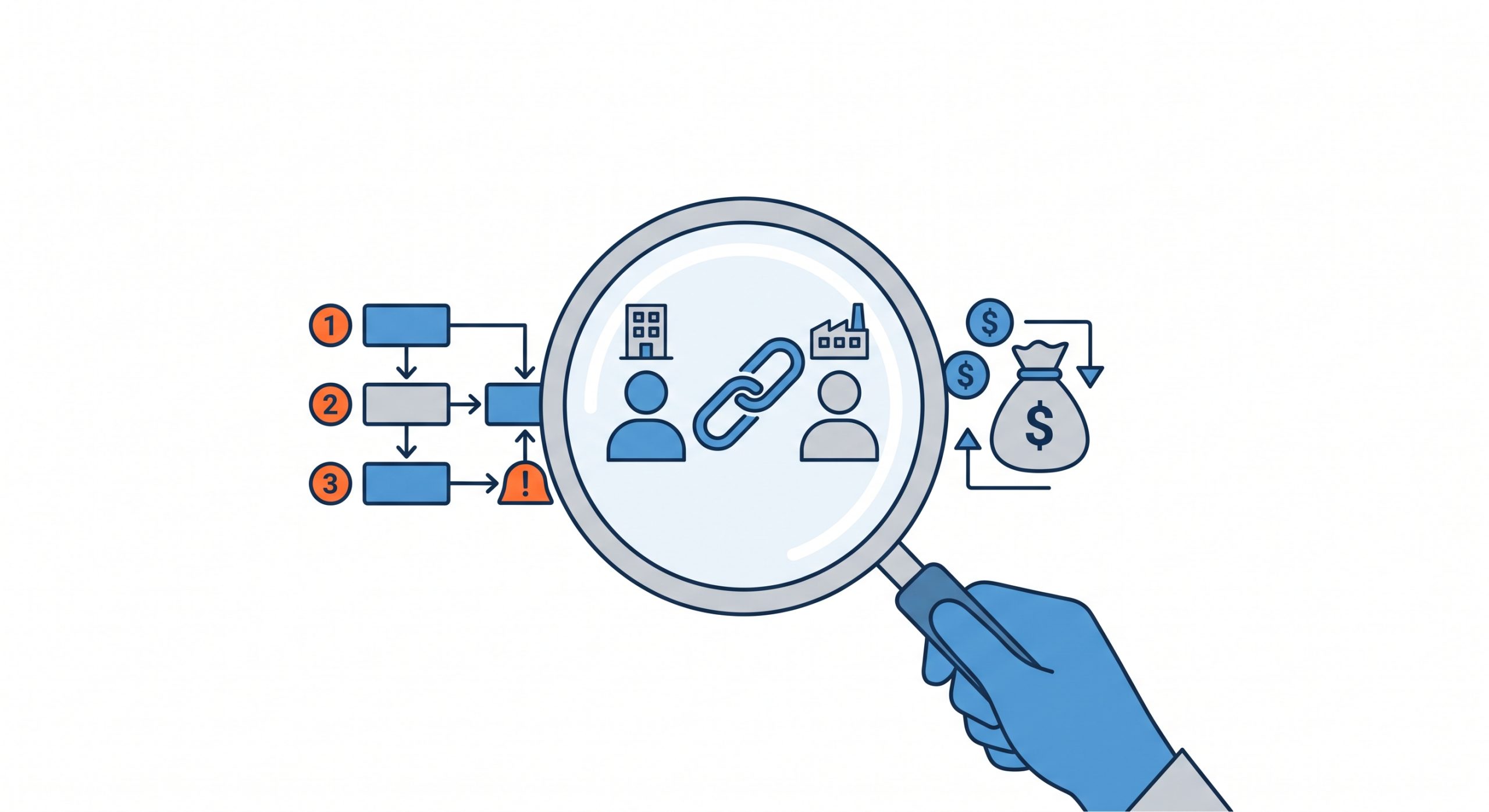
When a company discovers that its purchasing manager or employees are suspected of accepting kickbacks from suppliers, the most important thing at the first moment is usually not to confront the employees immediately, nor to decide whether to sue for breach of trust or embezzlement, but to preserve the evidence.
The real questions to investigate in procurement kickback cases are: What purchasing authority did this employee originally have? Why did the supplier pay him? Did the purchase price increase as a result? Did the company lose discounts or better terms it could have obtained? Were there any false quotes, false invoices, inflated prices, or transactions involving related parties? Did the kickback ultimately flow to the employee, their relatives, or other companies?
If a confrontation is brought too early, the relevant parties may delete LINE messages, emails, quotation information, or supplier records. If a lawsuit is filed based on a single private remittance, the case may fall into a conflict of accounts because the relationship between the purchasing decision, the kickback, and the company's damages cannot be proven.
Therefore, when a company discovers that an employee has accepted kickbacks, it should first connect the five issues of "procurement process, supplier relationship, company payment, private interests and company damages" before deciding on criminal, labor and civil procedures.
uncertain.
Commercial transactions may naturally involve formal commissions, discounts, bonuses, referral fees, or channel rebates. If the company was aware of and agreed to these arrangements, and the ownership of funds, conflicts of interest, and accounting treatment have been transparently disclosed, then a crime cannot be directly concluded simply because someone received the word "commission."
The truly high-risk situation is another one.
For example, a purchasing manager has the authority to select suppliers, determine specifications, obtain quotations, negotiate prices, accept goods, or recommend payments. However, they may privately agree with a specific manufacturer: "For every million dollars the company buys, you will give me an additional 50,000 dollars." In order to pay this private benefit, the manufacturer may then add the cost to the company's purchase price. Or, even if the price does not increase significantly, the manager may still give up trying to get discounts for the company, comparing other suppliers, or selecting suppliers through normal procedures because of their private interests.
At this point, the issue is no longer just whether the employee received the money, but whether the employee abused their authority to handle procurement matters on behalf of the company, thus violating their original task of making decisions for the company's benefit.
This is also the biggest difference between "legal commissions" and "secret kickbacks".
When a purchasing manager of a private company accepts kickbacks from suppliers, the law usually first investigates the matter.Article 342 of the Criminal LawBreach of trust.
Breach of trust is not necessarily established simply because an employee receives personal gain. The law must further determine: Was the employee acting on behalf of the company? Did the employee intend to obtain illegal benefits for themselves or a third party, or to harm the company's interests? Did the employee engage in any conduct contrary to their duties? Did the company suffer any financial or other financial loss as a result?
The statutory penalty under Article 342 of the current Criminal Code is imprisonment for up to five years, detention, or a fine of up to NT$500,000, or both. Attempted offenses are also subject to penalties.
The reason why procurement managers are prone to breach of trust is that procurement work is usually not a simple mechanical execution, but involves different degrees of discretion in supplier selection, price comparison, negotiation, specifications, delivery time, payment terms, acceptance or recommendation, etc.
If an employee represents the company in negotiating deals with suppliers while also privately accepting personal benefits from those suppliers, a classic conflict of interest may arise.
However, the company still needs to prove the specific facts. A simple statement like "he took kickbacks" cannot replace complete evidence of procurement, cash flow, and damages.
To further understand the difference between breach of trust and misappropriation of business, please refer to "What's the difference between breach of trust and embezzlement? How to determine if company funds have been taken?。
Procurement kickback cases can easily involve both "breach of trust" and "embezzlement" charges, but the two should not be confused.
The core of business embezzlement is that the perpetrator originally held specific property belonging to another person due to a business relationship, but later appropriated that property for their own use. Current...Article 336, Paragraph 2 of the Criminal LawThe regulations stipulate that misappropriation of property held in the course of business is punishable by imprisonment for a term of not less than six months and not more than five years, and may also be subject to a fine of not more than NT$90,000.
If a supplier pays the purchasing manager privately with their own money, that money is usually not company property entrusted to employees for safekeeping. This situation cannot be automatically concluded as embezzlement simply because "an employee took the money."
相反地,如果案情是員工原本保管公司的採購款、退款、折讓款或供應商應返還給公司的款項,後來卻私自留下,這時才更需要檢查是否涉及業務侵占。
Therefore, procurement fraud cases cannot simply focus on "whether money went into employee accounts," but must first confirm who the money originally belonged to, why the payment was made, and what ownership relationship the employee originally had with the assets.
Many procurement kickback cases are not simply "the manufacturer giving the employee a sum of money privately", but are accompanied by another arrangement in which the company makes the payment.
For example, the purchasing manager and the supplier agree on a real price of one million yuan, but submit a quote of one million two hundred thousand yuan to the company; or find other related companies to make a formal bid to make a specific supplier appear to have the lowest price; or even fabricate services, consulting fees, equipment or engineering projects that do not actually exist, and then have the company pay for them.
If individuals mislead a company into making payments through false transactions, fake quotes, or other misleading information, it may further involve criminal fraud issues.Article 339 of the Criminal LawCurrently, the statutory penalty for using fraudulent means to induce someone to hand over property with the intent to illegally possess it for oneself or a third party is imprisonment for up to five years, detention, or a fine of up to NT$500,000, or both.
However, not all purchases that seem "overpriced" constitute fraud. Market prices naturally fluctuate depending on brand, specifications, delivery time, payment terms, warranty, and purchase quantity. If a company wants to claim that suppliers and employees conspired to inflate prices, it must provide concrete evidence of the actual transaction terms and the misinformation at the time.
In some procurement fraud cases, fake transactions are designed to allow kickbacks to enter the company's payment process.
For example, if only one million yuan worth of equipment is actually provided, but the invoice is issued for one million two hundred thousand yuan; if no consulting services are provided, but a claim is made under the guise of consulting fees; or if accounting vouchers are prepared for projects, marketing, maintenance, commissions, or service fees that do not exist.
If someone within the company knowingly fills out, records, or assists in the creation of false accounting vouchers, ledgers, or financial data, it may further create risks under commercial accounting law.
However, this part still needs to consider the identity and behavior of the actual participants. It is wrong to assume that all purchasing personnel, accountants, and company leaders are guilty simply because there are errors in the accounts.
If the case involves issues with false invoices, summonses, accounting books, or financial statements, further reference can be made to "What are the common violations of commercial accounting law? A comprehensive overview of everything from falsified accounting vouchers and ledgers to inaccurate financial statements.。
The most important thing is usually not to fire them immediately, nor to immediately question them: "Did you take money from the manufacturer?"
Instead, the company should first confirm the information it currently possesses and preserve any evidence that may be lost.
The first stage should be to establish a standardized procurement process. This includes procurement requests, price inquiries, price comparisons, supplier profiles, price negotiations, approvals, orders, contracts, acceptance, and payment requests and documentation. It's also crucial to first confirm the specific steps where the employees involved have actual authority.
The second stage involves organizing supplier relationships. The company can examine when a supplier started trading, how the transaction amount changed, whether they suddenly replaced the original supplier, whether their quotes lacked competition for a long period, whether they were always recommended by the same manager, and whether specific suppliers received unusual preferential terms.
The third stage is the cash flow. In addition to the bank records of the company's payments to suppliers, you should also pay attention to whether there are any unreasonable financial transactions between suppliers, responsible persons, employees, spouses, relatives, or related companies in the existing legally obtained information.
The fourth stage involves communication and digital data. Company emails, procurement systems, ERP systems, CRM systems, company-issued equipment, work groups, and legally retained documents can all potentially reconstruct the actual procurement process.
These materials should be preserved in their original versions, sources, and dates as much as possible; it is not advisable to arbitrarily modify the files while conducting the investigation.
This interpretation is inappropriate.
An internal investigation by a company does not mean that it has unlimited access to all of its employees' private information.
The legal basis for a company's own email system, ERP, procurement system, company-issued equipment, and information that falls under the company's management scope according to work rules and information security policies is different from that of an employee's completely private mobile phone, private email, private cloud account, or private financial information.
Therefore, evidence preservation does not mean "taking everything to look at first".
If it is necessary to access personal devices, private accounts, communications, or other highly confidential information, the company should first confirm whether it has the legal authority and appropriate procedures to avoid turning an investigation into employee fraud into a dispute over privacy, personal data, or the legality of evidence.
The most important thing is to first secure the information that the company can legally control and retain.
This is often the most important, yet most easily overlooked, aspect of the entire case.
如果員工收了供應商五十萬元回扣,不能當然直接推論公司的損失就是五十萬元。
The company's real damage may manifest itself in different ways.
For example, a supplier might initially offer the company a 10% discount, but end up paying the company the original price because they need to pay a personal kickback to the manager; or employees might forgo other manufacturers with lower prices, better quality, or better terms in order to consistently choose a particular supplier; or the company might actually pay more than the normal transaction amount due to inaccurate pricing.
Conversely, if a supplier claims that it paid a personal sum from its own profits, and that the price, quality, and terms obtained by the company were completely unaffected, the company must still specify what property or other interests were harmed by the employee's breach of duty.
Therefore, a truly effective investigation cannot simply focus on "how much kickback is involved." It must also compare market prices, historical purchase prices, other quotations, discounts that the company could have obtained, quality, delivery time, payment terms, and the supplier selection process.
A single anomaly usually cannot directly prove kickbacks, but when multiple anomalies occur simultaneously, further cross-referencing is worthwhile.
For example, a purchasing manager insists on using the same supplier for a long time, even if the price is not obviously advantageous; other manufacturers never have the opportunity to formally quote; the format or content of each price comparison report is unusually similar; the supplier's contact person has a close personal relationship with the manager; the purchase price suddenly drops after the person in charge is changed; after the supplier obtains the order, they pay the employee or their associates under the guise of consulting fees, referral fees or other names.
None of these are pieces of evidence that, on their own, can constitute a conviction.
The real value lies in putting them back on the same procurement timeline and cross-referencing them with contracts, quotes, company payments, and private interests.
There is no fixed order that applies to all cases.
If employees still have access to payment authority, procurement systems, important files, or supplier contacts, the company may need to make appropriate permission adjustments and risk controls to prevent the case from escalating or data loss.
However, "discovering suspicious activity" and "having sufficient evidence to prove a major violation" are not the same thing.
If the company considersArticle 12 of the Labor Standards ActSection 1, paragraph 4, allows for termination of an employment contract without prior notice on grounds of serious breach of the employment contract or work rules, subject to additional legal time requirements. In principle, the employer should take such action within 30 days of becoming aware of the situation.
Whether the legal definition of "knowledge" is met, and whether the employee's behavior constitutes "serious misconduct," still depends on the company's actual investigation results, work rules, job authority, and evidence.
Therefore, companies should not delay indefinitely, but they should also not hastily dismiss employees based solely on rumors before the evidence is secured, which could lead to both insufficient criminal evidence and labor disputes.
It usually depends on where the current evidence gaps are.
If the company had disclosed all the suspected information to the employees and suppliers involved from the outset, it might have led to a more consistent account of the events, but it could also have increased the risk of data loss.
A more conservative approach is to first reconstruct the transaction from existing objective documents and then decide on the order of interviews.
Companies need to know what they already have, rather than "guessing cases" based on the first interview.
After the purchase records, company payments, quotations, supplier information, and existing communications have been roughly compiled, interviews should be conducted with the person in charge, supervisor, accountant, user department, and supplier. This usually makes it easier to determine whether the statements of each party are consistent with the objective data.
The interview record itself should clearly record the time, participants, materials presented, and actual statements made by the interviewee, and it is not advisable to add content that did not happen afterward.
possible.
Suppliers are not necessarily witnesses in a case.
If it is merely an employee unilaterally demanding personal gain, the supplier's legal role may differ from the employee's; however, if the supplier and purchasing personnel collude beforehand to arrange false quotes, inflated prices, fake transactions, fake acceptances, or other methods to force the company to pay amounts that should not have been paid, then it is necessary to examine the supplier's actual involvement in these actions.
Different facts may involve different issues such as fraud, paperwork, business accounting, or collusion with company insiders.
Therefore, when a company files a criminal complaint, it should not simply state "the employees colluded with the manufacturers," but should explain the role and actions of each individual.
A criminal complaint is not about handing over all the company's accounting books to the prosecutor and asking them to find the problems themselves.
A more complete criminal complaint against a company should first organize the events into a understandable structure.
First, explain the employee's position and purchasing authority. Then, explain how specific suppliers entered the purchasing process, which purchases were handled by this employee, and any anomalies in prices and terms. Finally, place company payments, suspected personal interests, and communications between the two parties on the same timeline.
Finally, the company explains the specific damages it suffered and what objective evidence supports this claim.
according toCriminal Procedure LawAs a victim, the company can file a criminal complaint in accordance with the law; the complaint or report can be made in writing or verbally to the prosecutor or judicial police officer.
If a case involves multiple people, long-term procurement, false quotes, company books, or complex cash flows, it is more important to first clarify the entire transaction structure than to only present a screenshot of a suspicious remittance.
Criminal liability and the company recovering its losses are two different things.
If the actions of an employee or supplier cause damage to the company, the company may further assess contractual liability, tort, unjust enrichment or other civil claims on a case-by-case basis.Article 184 of the Civil CodeIt also regulates the liability for damages when intentionally or negligently infringing upon the rights of others.
However, civil claims still require proof of damages and causation.
Therefore, the company needs to calculate the "rebate amount", "illegal gains of suppliers", "actual overpayment amount of the company" and "other damages to the company" separately, and should not mix them all into the same number.
If there is a specific risk of asset stripping, further assessment can be made based on actual evidence to determine whether civil preservation measures are necessary.
no.
This article primarily addresses the issue of kickbacks between purchasing managers, employees, and suppliers within a private company.
If the case involves civil servants, public works projects, or the purchase of office equipment or supplies, it may enter into [a certain category].Corruption Punishment OrdinanceThe legal framework is completely different. Furthermore, the law has specific and severe criminal provisions for accepting kickbacks through office construction projects or the purchase of office equipment and supplies.
Therefore, if the so-called "procurement kickbacks" involve government agencies, public schools, public enterprises, or personnel with civil servant status, the analytical methods used for breach of trust by employees of general private enterprises cannot be directly applied. The identity of the person involved and the nature of the procurement should be confirmed separately.
The first mistake is to conclude a crime based solely on a single sum of money. Kickback cases still require establishing the reasons for the payment, the authority to make the purchase, and the relationship between personal interests and corporate damage.
The second mistake was confronting them too early. Notifying all those involved before having solid evidence could make it more difficult to reconstruct the original transaction later.
The third mistake is arbitrarily accessing employees' private accounts or devices for the purpose of investigation. Internal corporate investigations still have boundaries of authority and privacy.
The fourth mistake is to only deal with the employees, not the suppliers and the system. If the problem stems from a long-term reliance on a single supplier, a lack of price comparison, or the same person being responsible for supplier selection, acceptance, and payment, simply dismissing one employee does not mean the risk has disappeared.
Purchase kickback cases are not usually decided based on a single LINE screenshot.
The real important thing is to put the four lines together.
The first line is the line of duties and decision-making: who has the authority to select suppliers, negotiate prices, accept goods, request payment and make payments.
The second line is the transaction line: what the company actually bought, what the reasonable price was, what the conditions of other manufacturers were, and why the supplier won the bid.
The third point is the cash flow: how much money the company pays to suppliers, and whether the suppliers subsequently have funds flowing to employees or related parties.
The fourth point concerns communication and document processing: whether quotations, emails, LINE, contracts, accounting documents, and internal approvals can correspond to each other.
Only when the four lines gradually overlap can the company determine whether it is a normal business transaction, a conflict of interest, an internal violation, or a criminal case.
This is alsoCorporate criminal and white-collar crime casesOne of the biggest differences from typical criminal cases is that the real answer often lies in the cross-referencing of corporate governance, procurement systems, accounting books, cash flow, and digital evidence.
In practice, the whole thing can be divided into four stages.
The first stage is evidence preservation. This involves securing the company's legally held procurement, accounting, system, and communication data to prevent the original evidence from being overwritten or lost.
The second phase is an internal investigation. This involves reconstructing the procurement timeline, authority, supplier relationships, pricing, and private interests to determine whether the problem stems from a single transaction or a long-term pattern.
The third stage is legal judgment. This involves distinguishing whether breach of trust, embezzlement, fraud, violations of commercial accounting laws, breaches of labor contracts, and civil damages are involved.
The fourth stage involves external legal action, including employee disciplinary action, supplier handling, criminal prosecution, civil claims, and necessary asset preservation.
The order of events is not meant to delay, but to prevent the company from making irreversible decisions before evidence has been established.
Not necessarily. It depends on the value of the gift, its frequency, company policy, whether it was declared, and whether it is related to a specific purchasing decision. General courtesy gifts and confidential benefits offered to secure orders are not legally evaluated the same way.
The company can file a lawsuit based on its legal assessment, but an employee receiving money is not the sole element constituting a breach of trust. Further evidence is needed to prove the employee's entrusted duties, breach of duty, illegal gains, or intent to cause harm, as well as the resulting financial or other damages suffered by the company.
Significant legal and corporate governance risks may still exist, but whether criminal breach of trust has been established requires specific confirmation of corporate damage. Rebate amounts cannot be automatically equated with corporate losses. Further examination should be conducted to determine whether the company has lost benefits that could have been obtained through normal negotiation or fair selection of suppliers.
是否可以調整工作、系統或付款權限,要依勞動契約、工作規則、職務必要性與具體風險判斷。公司可以先做必要的資訊與財務風險控制,但不代表可以任意停職、減薪或作出不符合勞動法令的處分。
These can be assessed separately. Termination of employment contract, criminal liability, and civil claims are different legal relationships. However, the company should still retain complete evidence of the investigation and termination, as the employee may raise separate labor disputes.
Based on the existing evidence, it can be assessed whether the case has reached the level for filing a criminal complaint or accusation. However, in corporate cases, if there is only speculation and a lack of objective data, subsequent investigations are prone to losing focus. Usually, all legally obtainable evidence, such as procurement records, quotations, company payments, supplier relationships, and communications, should be compiled first.
If a company discovers that its purchasing manager, employees, or other senior personnel are suspected of receiving kickbacks or personal commissions from suppliers, or that there are abnormalities in purchasing prices, quotations, payments, and relationships with suppliers, it should first save the purchasing process, contracts, quotations, invoices, accounting books, bank information, company emails, work communications, and authorization records.
Fidelity Law Firm can assist companies in establishing a complete timeline of events, including procurement processes, job authority, accounting records, cash flow, and digital evidence. They can assess breach of trust, embezzlement, fraud, commercial accounting laws, and related civil and criminal liabilities, and plan internal investigation, criminal prosecution, and subsequent compensation strategies based on the case circumstances.
Tel:02-7709-3611
LINE:@fdlaw
Email:info@fdlaw.com.tw
