Telephone
02-77093611
Line
@fdlaw
address
17th Floor, No. 180, Section 2, Dunhua South Road, Da'an District, Taipei City
Telephone
02-77093611
Line
@fdlaw
address
17th Floor, No. 180, Section 2, Dunhua South Road, Da'an District, Taipei City

Ma Ying-jeou's glorious past is still vivid in memory, but his later years are marred by family turmoil, a truly heartbreaking situation. His family has filed a petition for a "defense of the law" against him. Dai Xialing, choked with emotion, revealed that Ma's eyes welled up with tears upon hearing the news. A review of Ma Ying-jeou's presidency in 2015: The 81-second handshake between Ma and Xi Jinping | Sanlih News reporter Liao Pinjun. News link: In 2015, former President Ma Ying-jeou met with Chinese President Xi Jinping in Singapore. That 81-second handshake was arguably one of the most glorious moments of his political career. However, 11 years later, this former head of state is embroiled in internal strife, with even his health being scrutinized. His family has filed a petition with the court for a "defense of the law" against him. It is said that upon hearing the news, Ma Ying-jeou's eyes welled up with tears. Fidelity Legal Services…
Department store in Zhongshan District, Taipei City, locks emergency exit; business owner admits oversight, corrected the same day | CTS News reporters Huang Rou-rong and Fang Qinian. News Link: Each floor of the building has emergency exits on its staircases, which are crucial for evacuating people in emergencies. However, some members of the public discovered that the emergency exits of a well-known department store next to the Zhongshan MRT station were locked with large padlocks, making them impossible to open, sparking online discussion. In response, the department store stated that it was because staff on site did not follow standard operating procedures. They said they immediately corrected the issue during a routine inspection that afternoon and will strengthen training and increase the frequency of inspections in the future. Lawyer Li Yu-sheng of Fidelity Law Firm stated that while emergency exits should normally be kept closed, they must be keyless to open when facing the escape route. The owner locking the first-floor escape exit has seriously affected…
Following a petition for "auxiliary declaration," Ma Ying-jeou reportedly called his elder sister's lawyer, stating that family members must provide evidence. The Ma Ying-jeou Foundation is embroiled in a financial discipline case, and the matter has escalated. It is understood that the Ma family has filed a petition with the Taipei District Court for a "auxiliary declaration," which, if successful, could affect Ma Ying-jeou's position as chairman of the foundation. It is rumored that Ma Ying-jeou immediately called his elder sister, Ma Yi-nan. However, lawyers analyze that in addition to family members needing to provide evidence of Ma Ying-jeou's mental instability, judges, in principle, will also require the respondent to undergo a mental evaluation when hearing auxiliary declaration cases. Lawyer Li Yu-sheng of Fidelity Law Firm stated that according to the Family Law Act, Ma Ying-jeou's family can provide evidence of Ma Ying-jeou's mental instability when applying for an auxiliary declaration, and judges, in hearing…
Ma Ying-jeou Forgot Lawyer's Name! Appears to Dispel Dementia Rumors but Raises More Doubts | FTV News Reporter Lin Yanjun News Link: The Ma Ying-jeou Foundation controversy continues, with the former president personally responding. However, he not only mispronounced his lawyer's name on camera, but the handwritten manuscript released by the foundation was also illegible, and he even publicly distanced himself from close relatives. It is understood that his elder sister, Ma Yi-nan, has formally filed for a "supporting declaration" in court to protect the former president, and the Taipei District Court will also commission Taipei Veterans General Hospital to conduct a mental evaluation. However, it has also been reported that the former president lost control of his emotions due to the handwriting on a table card during his visit to China last June. Lawyer Li Yu-sheng of Fidelity Law Firm stated that when a family files for a supporting declaration, the court must base its decision on the relevant evidence provided by the family and the potential subsequent mental evaluation…
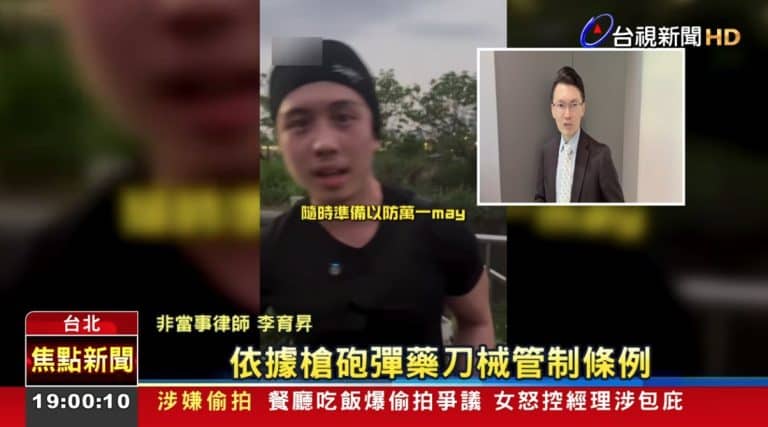
Three guns found at his residence! Sun An-tso detained on four charges | TTV News reporter Huang Yu-zhen News link: Sun An-tso, son of celebrities Di Ying and Sun Peng, was granted detention and incommunicado confinement by the Shilin District Court. He made a "god-level flamethrower" claiming it was to eliminate rats, but the matter escalated. Police searched his home and unexpectedly found a replica gun, a suspected modified shotgun, and sensitive firearm components. He faces four charges including intimidation of the public and violations of the Firearms, Ammunition and Knives Act. The court considered concerns about evidence collusion and destruction, therefore granting detention and incommunicado confinement. He was transferred to the Taipei Detention Center that evening. Lawyer Li Yu-sheng of Fidelity Law Firm stated that the modified gun seized from Sun An-tso's home was confirmed to have a kinetic energy exceeding 20 joules, possessing lethality. The judge considered the suspicion of serious criminal activity and the risk of flight, therefore ordering detention and incommunicado confinement…
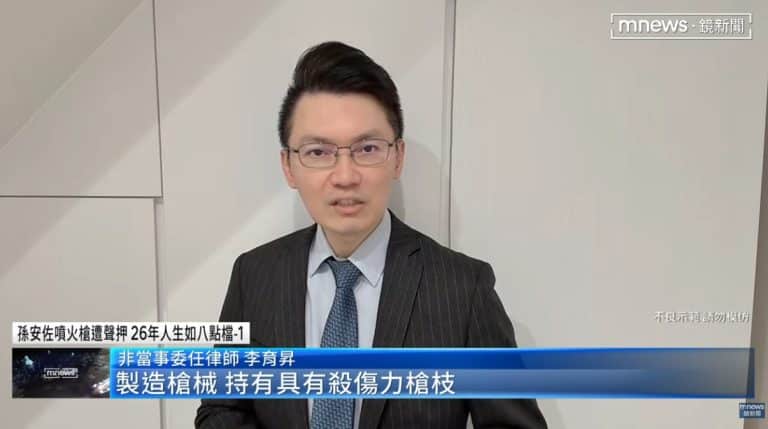
Sun An-tso has been detained and is expected to spend the night in a detention cell. The Shilin District Court is scheduled to hold a hearing at 2:30 PM today. Sun An-tso recently tested a homemade flamethrower at a riverbank in Beitou. Due to its excessive power, it immediately attracted the attention of the local police. Yesterday (the 16th), police and prosecutors searched Sun An-tso's residence and found suspected modified firearms. He was immediately taken in for questioning and subsequently detained and is expected to spend the night in a detention cell. The Shilin District Court is scheduled to hold a hearing at 2:30 PM today (the 17th). Legal experts believe the probability of his detention is quite high. Lawyer Li Yu-sheng of Fidelity Law Firm stated that police also unexpectedly found a replica gun and suspected parts for modified firearms at Sun An-tso's residence. The focus of the investigation has shifted to the manufacture and possession of firearms and ammunition under the Firearms, Ammunition and Knives Control Act…