Telephone
02-77093611
Line
@fdlaw
address
17th Floor, No. 180, Section 2, Dunhua South Road, Da'an District, Taipei City
Telephone
02-77093611
Line
@fdlaw
address
17th Floor, No. 180, Section 2, Dunhua South Road, Da'an District, Taipei City


Remember these four principles: 1. Premarital property does not automatically become jointly owned by the couple upon marriage; 2. Inherited property or property given as a gift by parents is generally not included in the remaining property balance; 3. Interest accrued on premarital property after marriage, as well as debts incurred after marriage, must be analyzed separately; 4. Most importantly, preserve evidence, because if it cannot be proven whether it was premarital or postmarital, the law generally presumes it to be postmarital property. Many people, when preparing for a divorce, have the following questions about property: "This house was bought before marriage, will it still be divided in the divorce?" "My parents gave me 5 million yuan after marriage, can my spouse claim half?" "I inherited my father's house, will that be included in the remaining property?" "I bought a house before marriage, but I've been paying the mortgage with my salary for ten years after marriage, how is that calculated?" "My premarital stocks have appreciated significantly, is the appreciation considered postmarital property?" These questions cannot be answered simply with "What's mine before marriage is mine, what's mine after marriage..."

Four things to do before a high-asset divorce: 1. Separate and organize company equity, stocks, real estate, investments, insurance, and liabilities; 2. Mark the acquisition time and source of funds for each asset; 3. Company assets must be separated from shareholders' personal assets; 4. First confirm the legal valuation date of the assets, then discuss their value. The real difficulty in high-asset divorces is usually not "how much money the couple has in total," but rather: Which assets should be included? When should they be valued? What is the actual value of the company? Are the liabilities real or just book figures? And how much of the remaining asset difference should be paid in the end? While typical divorce cases may primarily deal with savings, houses, and mortgages, the asset structure of business owners, doctors, professionals, investors, or high-income families often includes: Company equity; Unlisted stocks; Listed stocks, ETFs, and funds; Multiple real estate properties; Insurance; Employee stock options or restricted stock; Sea…

If you discover your spouse has transferred assets before the divorce, do four things first: 1. Preserve information on assets that you can currently legally obtain; 2. Organize the timing, amount, and flow of asset transfers; 3. Don't assume that all disposals within five years automatically constitute asset disposal; 4. If there is a risk of continued transfer, promptly assess whether to add to the asset calculation, cancel the asset disposal, switch to a separate property regime, or apply a provisional attachment. One of the most nerve-wracking situations after a couple begins discussing divorce is suddenly discovering that their partner has started transferring money out of the bank. For example, suddenly withdrawing large sums from bank deposits that previously held millions of dollars; transferring property to parents, siblings, or friends; stocks being sold and the funds disappearing; sudden transfer of company shares; large "loans" appearing on the books that weren't there before; or even the spouse directly stating, "I have no assets left, and you won't get any." The first issue to clarify at this point is: a spouse transferring assets doesn't necessarily mean that it won't be counted under the law; but it also doesn't…

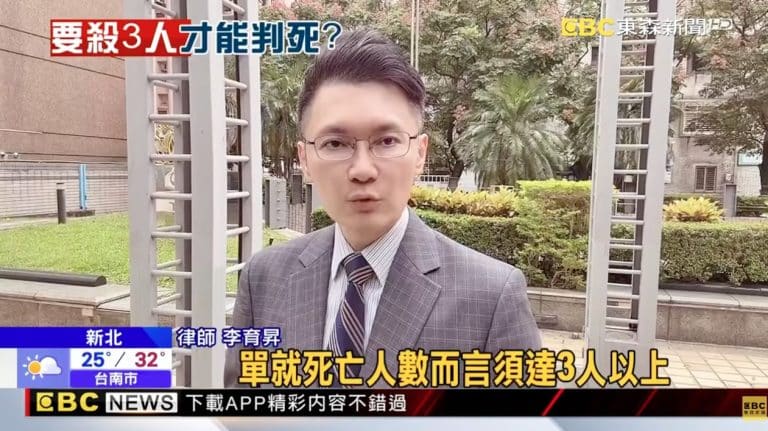
News Headline: Domestic Abusive Man Kills Wife, Sister-in-Law Escapes Death; New Taipei District Court: Death Sentence Required for 3 Kills Media Source: ETtoday News Reporter: Zhao Yijie News Link: News Summary According to ETtoday News, a man in Tucheng District, New Taipei City, killed his wife and sister-in-law in May 2025 and was sentenced to two life sentences in the first instance. The report relayed that the New Taipei District Court offered a case-by-case interpretation of the "most serious circumstances of the crime" and "killing multiple people" requirements for a death sentence, believing that "multiple people" must be at least three, which sparked dissatisfaction from the victim's family regarding the sentencing result. This controversy involves how to apply the Constitutional Court's 113th year Constitutional Judgment No. 8 to individual cases, and the death penalty threshold cannot be generalized from news headlines alone. Lawyer Li Yusheng's Explanation: Lawyer Li Yusheng of Fidelity Law Firm pointed out in the news that this kind of interpretation...
News Headline: "Sunflower Movement Queen" Liu Qiaoan Suspected of Smuggling Cocaine, a Class I Narcotic, with a Maximum Penalty of Death Media Source: FTV News Reporters: Li Yuhan, Ye Yansheng News Link: News Summary According to FTV News, Liu Qiaoan was indicted by prosecutors after being extradited back to Taiwan. Prosecutors accused her of participating in a transnational drug trafficking ring, acting as an intermediary for Taiwanese buyers, and smuggling cocaine into Taiwan by air using candles. The report indicated that the New Taipei District Prosecutors Office is pursuing charges including transporting Class I narcotics. The above content pertains to the prosecution's charges; whether a crime has been committed and the final sentence will still be determined by the court based on evidence. Lawyer Li Yusheng Explains: Lawyer Li Yusheng of Fidelity Law Firm explained the significant legal risks of transnational drug trafficking in the news report. Cocaine is a Class I narcotic, and Article 4, Paragraph 1 of the Narcotics Hazard Prevention Act…